
Introduction
You have a tooth that is bothering you. Maybe it is sensitive to sweets or cold drinks. Maybe it has a visible crack, or your dentist has pointed out some decay on an X-ray. Either way, you are now faced with a choice between two treatments, a filling or a crown, and you are not entirely sure why one would be recommended over the other.
You are not alone in this. It is one of the most common questions people have when they visit a dental clinic, and honestly, the confusion makes total sense. Both treatments fix a damaged tooth. Both are done in the dentist’s chair. So what is the actual difference, and how does your dentist decide?
This guide is going to break it all down in simple terms, so that by the end you will have a clear picture of what each treatment does, when each one is the right choice, and what to expect if you need one at Kranti Dental Care, the best dental clinic in Chhatrapati Sambhajinagar.
What Is a Tooth Filling?
A dental filling is used to repair a tooth that has a small to medium-sized cavity or a minor chip. During the procedure, the dentist removes the decayed or damaged portion of the tooth and fills the space with a material that restores the tooth’s shape and function.
The most common type of filling today is composite resin, a tooth-coloured material that bonds directly to the tooth and looks completely natural. Amalgam (silver) fillings are also used in some cases, though they are less popular now for front and visible teeth.
Fillings are typically completed in a single appointment and are the most straightforward form of tooth restoration.
When Is a Filling the Right Choice?
A filling is usually the right option when:
- The cavity is small to moderate in size
- Less than half the tooth structure has been lost to decay
- The tooth is not cracked or structurally weakened
- The damage has not reached or significantly affected the inner pulp (nerve) of the tooth
- The tooth does not have a previous large filling that needs to be replaced
What Is a Dental Crown?
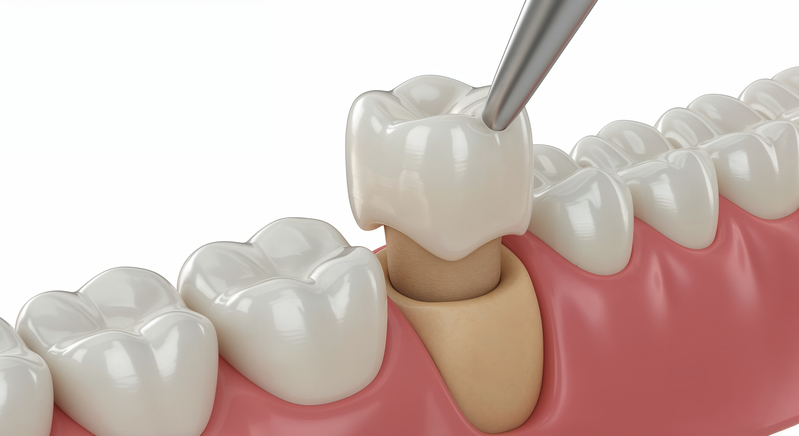
A dental crown is a custom-made cap that fits completely over the entire visible portion of a tooth, from just above the gumline upward. It encases the tooth, protecting and strengthening it while restoring its original shape, size, and function.
Crowns are made from several materials including porcelain, ceramic, metal alloy, or a combination. Porcelain and ceramic crowns are popular because they closely match the natural colour of teeth. Metal crowns are sometimes used for back molars where durability is the priority.
Getting a crown typically involves two appointments. In the first, the tooth is shaped, impressions are taken, and a temporary crown is placed. In the second appointment, the permanent custom crown is fitted and cemented.
When Is a Crown the Right Choice?
A crown is recommended when:
- More than half the tooth has been lost to decay or damage
- The tooth is cracked or fractured and at risk of splitting
- A tooth has just had a root canal treatment (which makes the tooth more brittle and prone to cracking)
- An old, large filling has failed and there is not enough healthy tooth structure left to support a new filling
- A tooth is severely worn down from grinding (bruxism)
- A tooth has broken at or near the gumline
- A dental implant needs a crown placed on top to function as a replacement tooth
Crown vs Filling: A Simple Side-by-Side Comparison
| Feature | Tooth Filling | Dental Crown |
| What it does | Fills a cavity or minor chip | Covers and protects the entire tooth |
| Best for | Small to medium decay | Large decay, cracks, post-root canal |
| Appointments needed | 1 | 2 (sometimes 1 with same-day technology) |
| Tooth structure required | Most of the tooth must remain | Only the root and base need to be intact |
| Durability | 5 to 10 years average | 10 to 15 years or longer |
| Appearance | Tooth-coloured, natural look | Can be made to match perfectly |
| Cost | Lower | Higher |
| Procedure time | 30 to 60 minutes | Two appointments of 60 to 90 minutes |
The Big Question: Why Can’t Everything Just Be Filled?
This is the part that trips people up most. If a filling is cheaper and simpler, why not just always go with a filling?
The answer is about tooth structure and long-term stability.
When a tooth has a small cavity, there is plenty of healthy structure left surrounding it. A filling bonds to that healthy structure and is completely stable. But when decay or damage has removed a large portion of the tooth, there simply is not enough tooth left for a filling to hold onto properly.
Think of it like a wall with a small crack versus a wall that has lost half its bricks. You can patch the crack easily. But if half the bricks are gone, patching is not going to hold. You need something that wraps around the whole structure and supports it.
A crown does exactly that. It distributes the biting force evenly across the entire tooth and protects whatever healthy structure remains underneath.
If a dentist recommends a crown and you only get a filling instead, you are very likely to find that the filling fails quickly, or worse, the tooth cracks under biting pressure and becomes unrestorable, meaning it would need to be extracted entirely.
What Happens If You Delay Treatment?
Delaying either treatment, whether it is a filling or a crown, allows the problem to get worse. Here is what typically happens when people put it off:
Delaying a filling: The cavity grows larger and deeper. What started as a small filling becomes a large one, or worse, the decay reaches the inner pulp and nerve of the tooth, requiring a root canal treatment in addition to the filling or crown. What could have been a simple 45-minute appointment becomes a multi-appointment process.
Delaying a crown: A tooth that needs a crown is already structurally weakened. Without the crown protecting it, the tooth can crack under normal biting forces. A cracked tooth is a dental emergency and, depending on where the crack extends, may no longer be saveable. Extraction followed by a dental implant or bridge is far more expensive than the crown that could have been placed earlier.
The cost of delay is almost always higher than the cost of treatment.
Will It Hurt? What to Expect During Each Procedure
Both fillings and crowns are done under local anaesthetic, which means the area is completely numb before any work begins. You should not feel any pain during the procedure itself.
For a filling:
Once the area is numb, the decayed portion is removed (you may feel vibration but not pain), the tooth is cleaned, and the filling material is placed and shaped. The whole process typically takes 30 to 60 minutes.
For a crown (first appointment):
The tooth is shaped to make room for the crown, an impression or digital scan is taken, and a temporary crown is placed. There may be some sensitivity around the temporary crown for a few days.
For a crown (second appointment):
The temporary crown is removed, the permanent crown is checked for fit and colour, and then it is permanently cemented in place. This appointment is usually shorter and more comfortable.
After either procedure, some mild sensitivity is normal for a few days. Over-the-counter pain relief handles this easily for most patients.
How to Take Care of Your Filling or Crown
With proper care, both fillings and crowns last for many years.
For fillings:
- Brush twice a day with fluoride toothpaste
- Floss daily, including around the filled tooth
- Avoid chewing on ice or very hard foods
- Visit your dentist regularly so the filling can be checked
For crowns:
- Brush and floss normally, including around the crown margin (where the crown meets the gum)
- Avoid chewing on hard or sticky foods that could dislodge the crown
- If you grind your teeth at night, ask your dentist about a nightguard to protect the crown
- Do not miss your regular dental check-ups
Dental Crowns and Fillings at Kranti Dental Care in Chhatrapati Sambhajinagar
At Kranti Dental Care, Dr. Pradyumna Doibale, Dr. Sunita Doibale, and Dr. Nikita Doibale bring a combined expertise in restorative and cosmetic dentistry to every patient who walks through the door. Whether you need a simple composite filling or a full porcelain crown, the approach is always the same: honest recommendations, comfortable treatment, and results that last.
The clinic is equipped with modern dental technology for precise impressions and crown fitting, and uses tooth-coloured materials for natural-looking results across all restorative treatments.
Kranti Dental Care is located at Om 25, Shri Vyankatesh Housing Society, Jawahar Colony Area, Near Chetak Ghoda Chowk, Chhatrapati Sambhajinagar, easily accessible from Ulkanagari, Osmanpura, Beed Bypass, and CIDCO. Call +91 9834878836 to book a consultation and find out exactly what your tooth needs.
Conclusion
Choosing between a filling and a crown is not really a choice you make, it is a decision based on the condition of the tooth. A good dentist will always recommend the most conservative treatment that will actually work and last. If a filling will do the job properly, you get a filling. If the tooth needs more support and protection, a crown is the right call.
What matters most is not delaying. The earlier you treat a damaged tooth, the simpler and more affordable the treatment tends to be.
If you have a tooth that has been bothering you, or if you have been putting off a dental visit, now is a great time to come in. The team at Kranti Dental Care, the best dental clinic in Chhatrapati Sambhajinagar, will give you a clear and honest picture of what your tooth needs and why.
FREQUENTLY ASKED QUESTIONS (FAQs)
Q1: How do I know if I need a crown or a filling?
The size and extent of the damage determines this. Small to moderate cavities are treated with fillings. When more than half the tooth has been lost, the tooth is cracked, or it has had a root canal, a crown is typically required. Your dentist will assess this through examination and X-rays.
Q2: Is getting a dental crown painful?
No. The procedure is done under local anaesthetic so the area is fully numb. You may feel vibration or pressure but not pain. Some sensitivity around the temporary crown is normal and settles within a few days.
Q3: How long does a dental crown last?
A well-made crown with good oral hygiene and regular dental checkups typically lasts 10 to 15 years. Porcelain-fused-to-metal and full ceramic crowns can last longer with proper care.
Q4: Can a cracked tooth be saved with a filling?
It depends on the size and location of the crack. A minor surface crack may be handled with bonding or a filling. However, a crack that extends deeper into the tooth structure typically requires a crown to prevent the tooth from splitting under pressure.
Q5: Why do I need a crown after a root canal?
A root canal removes the nerve and blood supply from inside the tooth, leaving it more brittle. Without a crown to protect it, the tooth is at high risk of cracking under normal chewing forces. A crown after a root canal is almost always recommended for back teeth.
Q6: Is a tooth filling permanent?
Fillings are long-lasting but not permanent. Composite resin fillings typically last 5 to 10 years. Over time they can wear, chip, or develop gaps around the edges, which is why regular dental checkups are important to catch any issues early.
Q7: What material is best for a dental crown?
For front teeth, full ceramic or porcelain crowns look the most natural. For back teeth, porcelain-fused-to-metal or zirconia crowns offer excellent strength. Your dentist will recommend the best material based on the tooth’s location and your specific bite.
Q8: Can I eat normally with a temporary crown?
You can eat, but it is best to avoid very hard, sticky, or chewy foods on the side of the temporary crown. The temporary is not as strong as the permanent crown and could come loose if stressed too much.
Q9: How long does it take to get a dental crown?
The process typically involves two appointments spaced one to two weeks apart. The first appointment is for shaping the tooth and taking impressions. The second is for fitting and cementing the permanent crown. Each appointment takes about 60 to 90 minutes.
Q10: Is a dental crown expensive?
Crowns cost more than fillings because they involve custom fabrication and more clinical work. However, the cost of not getting a crown when one is needed, such as a tooth that cracks and needs extraction followed by an implant, is significantly higher. Kranti Dental Care provides transparent pricing and honest treatment recommendations.