
Introduction
If you are an adult thinking about braces, you have probably already asked yourself at least once: is it too late? Maybe you had braces as a teenager but your teeth shifted. Maybe you could never afford treatment growing up. Or maybe you simply never got around to it and now you are wondering if there is even any point.
Here is the short answer: it is absolutely not too late.
Braces are not just for teenagers. In fact, adults make up a significant and growing proportion of orthodontic patients across India. More adults are choosing to straighten their teeth now than at any point in history, and the options available today are far more discreet and comfortable than what most people picture when they think of braces.
This guide is going to walk you through everything you need to know, from whether there is really an age limit, to the different types of treatment available, to what you can realistically expect from adult orthodontic treatment at the best dental clinic in Chhatrapati Sambhajinagar.
Is There an Age Limit for Braces?
No. There is no upper age limit for orthodontic treatment.
Braces and aligners work by applying gentle, consistent pressure to teeth, which causes the bone surrounding the tooth roots to remodel slowly and allow the teeth to shift into new positions. This process works the same way in adult bone as it does in younger bone. It may take slightly longer in adults because adult bone is denser and less pliable than a child’s, but it works just as effectively.
The only real requirement for orthodontic treatment is that your teeth and gums are in reasonable health. If you have active gum disease or significant untreated decay, those issues would need to be addressed first. But once your mouth is in good shape, there is no biological reason you cannot straighten your teeth.
The British Orthodontic Society reports that around one in four orthodontic patients today is an adult. That number is even higher for clear aligner treatments. The idea that braces are only for kids is genuinely outdated.
Why Do Adults Seek Braces in the First Place?
Adults pursue orthodontic treatment for a wide range of reasons, and most of them are entirely valid:
Teeth that shifted after teenage braces: Many people wore braces as teenagers but stopped wearing their retainer. Over time, teeth gradually drift back toward their original positions. This is one of the most common reasons adults come in for a second round of treatment.
Crowding or spacing that was never treated: Plenty of adults never had the chance to get braces when they were younger, whether due to cost, access, or simply not prioritising it at the time. There is no reason to keep putting it off.
A change in priorities: People in their 30s and 40s often reach a point where they decide that improving their smile is worth investing in. Starting a new career, preparing for a wedding, or simply wanting to feel more confident can all be valid motivations.
Jaw-related issues: Some adults seek orthodontic treatment because of bite problems such as overbite, underbite, or crossbite that cause discomfort while chewing, jaw pain, or headaches.
What Are the Benefits of Straightening Your Teeth as an Adult?
The benefits of orthodontic treatment go well beyond aesthetics:
Better oral hygiene: Crowded or overlapping teeth are much harder to clean properly. Food and plaque get trapped in tight spaces where brushing and flossing cannot reach easily. Straighter teeth are genuinely easier to keep clean, which reduces your risk of cavities and gum disease.
Improved bite and chewing function: A misaligned bite can cause uneven wear on your teeth over time and put stress on the jaw joint (TMJ). Correcting the bite improves chewing efficiency and can relieve jaw pain or headaches caused by bite imbalance.
Increased confidence: This one is straightforward. When you feel good about your smile, you smile more. Research consistently shows that people who are happy with their teeth report higher self-confidence in both personal and professional settings.
Long-term dental health: Straight teeth are easier to maintain and less prone to uneven wear. Investing in orthodontic treatment now can reduce the need for more complex restorative work later.
What Types of Braces Are Available for Adults?
One of the biggest reasons more adults are seeking orthodontic treatment is the variety of options now available. You are not limited to the metal braces of your school days.
Traditional Metal Braces
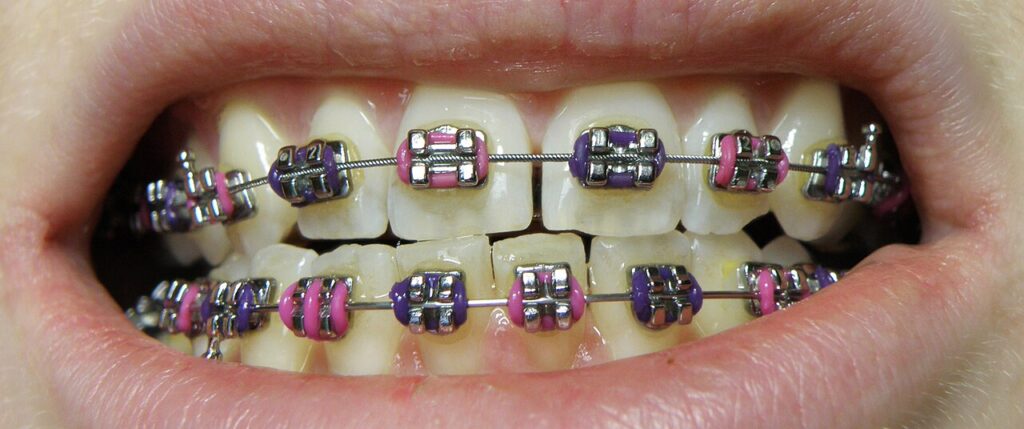
Metal braces are highly effective, reliable, and the most cost-effective option. They consist of metal brackets bonded to the teeth with a wire running through them that is periodically tightened to guide teeth into position. Modern metal braces are sleeker and more comfortable than older versions. For complex tooth movements, metal braces are often the most precise option.
Ceramic Braces
Ceramic braces work the same way as metal braces but use tooth-coloured or clear brackets that blend with the natural colour of your teeth. They are far less noticeable than metal braces and popular with adults who want effective treatment with a lower-profile appearance.
Clear Aligners
Clear aligners (such as brands like Invisalign or similar systems) are a series of removable, custom-made transparent trays that fit over your teeth. Each tray moves your teeth slightly, and you progress through the series over several months. They are nearly invisible when worn and can be removed for eating and cleaning. They work well for mild to moderate cases.
Lingual Braces
Lingual braces are attached to the back (tongue side) of the teeth, making them completely invisible from the front. They are a good option for adults who want maximum discretion but are not candidates for aligners. They do tend to be more expensive and take some adjustment in terms of speech initially.
Metal Braces vs Clear Aligners: Which Is Better for Adults?
Both options work well for adults, but the right choice depends on your specific situation:
| Feature | Metal Braces | Clear Aligners |
| Visibility | Noticeable | Nearly invisible |
| Effectiveness | Excellent for all cases | Best for mild to moderate cases |
| Removable? | No | Yes |
| Oral hygiene | More effort needed | Easier (remove to clean) |
| Eating restrictions | Some foods to avoid | No restrictions (remove to eat) |
| Treatment time | 12 to 24 months typically | 6 to 18 months typically |
| Compliance required | Fixed, no choice | High (must wear 20 to 22 hours daily) |
| Cost | Lower | Higher |
For adults with complex bite issues or significant crowding, metal or ceramic braces are often the more reliable choice. For adults with milder alignment concerns who prioritise discretion, clear aligners are an excellent fit.
Your dentist will assess your specific case and help you decide which system suits you best.
How Long Does Adult Orthodontic Treatment Take?
Treatment duration varies based on the complexity of your case and the type of braces chosen. Here is a general guide:
- Minor spacing or crowding: 6 to 12 months
- Moderate cases: 12 to 18 months
- Complex bite issues or significant crowding: 18 to 24 months
Adult treatment can sometimes take a little longer than the same treatment in a teenager because adult bone remodels more slowly. However, for many adults with mild to moderate issues, treatment times are quite comparable.
The most important thing is to follow your dentist’s instructions, attend adjustment appointments regularly, and wear any retainers as instructed after treatment.
Are Braces Painful as an Adult?
This is one of the most common concerns, and the honest answer is: there is some discomfort, but it is very manageable.
When braces are first placed, and after each adjustment appointment, your teeth will feel tender and sensitive for a few days. This is completely normal and is actually a sign that the process is working. The teeth are moving. Over-the-counter pain relief such as paracetamol handles this easily for most people.
Metal braces can sometimes cause irritation to the inner cheeks and lips until the soft tissue toughens up, typically within the first few weeks. Orthodontic wax applied to any sharp or poking areas helps significantly.
Clear aligners cause less soreness overall but do cause some pressure and discomfort when you switch to a new tray.
Adults often report that they found the discomfort manageable and less of a big deal than they expected. The results are worth it.
What You Should Know Before Starting Treatment
A few things worth understanding before you commit:
Retainers are not optional. After your braces come off, you will need to wear a retainer to keep your teeth in their new positions. This is non-negotiable. Teeth will shift without one. Your dentist will advise you on the retainer schedule, but most adults wear a retainer at night indefinitely.
Oral hygiene requires more effort during treatment. With braces, food gets trapped more easily. You will need to brush after every meal and floss carefully around the brackets and wire. A water flosser can be very helpful. Neglecting hygiene during treatment can lead to cavities or white spot lesions on the teeth.
Attendance matters. Missing adjustment appointments slows down treatment and extends the overall timeline. Plan your schedule around your appointments.
Results are permanent with proper retention. If you wear your retainer consistently, the results of orthodontic treatment last a lifetime.
Adult Braces at Kranti Dental Care in Chhatrapati Sambhajinagar
At Kranti Dental Care, Dr. Pradyumna Doibale, Dr. Sunita Doibale, and Dr. Nikita Doibale are experienced in providing orthodontic treatment for adults of all ages. Whether you are dealing with crowding, spacing, a shifted bite, or simply teeth that have never been quite right, the team will assess your case thoroughly and give you an honest recommendation for the most suitable treatment.
The clinic offers metal braces, ceramic braces, and clear aligner options, all in a comfortable and friendly environment with honest, transparent pricing.
Kranti Dental Care is located at Om 25, Shri Vyankatesh Housing Society, Jawahar Colony Area, Near Chetak Ghoda Chowk, Chhatrapati Sambhajinagar, and is convenient to reach from Ulkanagari, Osmanpura, Beed Bypass, and CIDCO. Call +91 9834878836 to book your orthodontic consultation.
Conclusion
If you have been waiting for permission to get braces as an adult, here it is: go ahead.
There is no age limit. The treatment works. The options are better than ever. And the benefits, healthier teeth, a more comfortable bite, and a smile you actually feel good about, are just as real for adults as they are for teenagers.
The only thing standing between you and straighter teeth is making the appointment.
Come in for a consultation at Kranti Dental Care, the best dental clinic in Chhatrapati Sambhajinagar. The team will take a good look at your teeth, walk you through your options, and help you decide on the best path forward. No pressure, just honest advice.
FREQUENTLY ASKED QUESTIONS (FAQs)
Q1: Is there an age limit for getting braces?
No. There is no upper age limit for orthodontic treatment. Adults of any age can straighten their teeth with braces or clear aligners, provided their gums and teeth are in reasonable health. The process works the same way in adult bone as in younger patients.
Q2: How long do adults usually wear braces?
Treatment time depends on the complexity of the case. Minor alignment issues may take 6 to 12 months. Moderate to complex cases typically take 12 to 24 months. Your dentist will give you a personalised timeline after examining your teeth.
Q3: Are clear aligners as effective as metal braces for adults?
Clear aligners work well for mild to moderate cases. For complex bite issues, significant crowding, or cases requiring precise tooth rotation, metal or ceramic braces are often more effective. Your dentist will recommend the right option based on your specific needs.
Q4: Will braces affect my speech?
There is typically a short adjustment period of one to two weeks during which your speech may be slightly affected, particularly with lingual braces or clear aligners. Most adults adjust quickly and speech returns to normal.
Q5: Can I get braces if I already have dental crowns or implants?
Yes, in most cases. Braces can be placed around crowns and existing dental work. However, implants are fixed in the bone and cannot be moved, which is something your dentist will take into account when planning your treatment.
Q6: Do I need to avoid any foods with braces?
With metal or ceramic braces, yes. You should avoid hard, crunchy, or sticky foods that can damage brackets or get trapped in wires, such as hard nuts, popcorn, chewing gum, and toffees. With clear aligners, you remove them before eating so there are no food restrictions.
Q7: What happens after braces come off?
Once braces are removed, you will receive a retainer to keep your teeth in their new positions. This is a critical part of treatment. Teeth naturally want to drift back without a retainer. Most adults wear a retainer nightly on a long-term basis.
Q8: Is orthodontic treatment more painful for adults than teenagers?
Not necessarily more painful, but the discomfort is similar. Some soreness and pressure after adjustments is normal for both adults and teenagers. Most adults find it very manageable with over-the-counter pain relief.
Q9: Can orthodontic treatment fix a bad bite in adults?
Yes. Orthodontic treatment can correct overbites, underbites, crossbites, and open bites in adults. In some cases, particularly for severe skeletal discrepancies, orthodontic treatment may be combined with surgical intervention, which your dentist will discuss with you if relevant.
Q10: Why should I choose Kranti Dental Care for adult braces in Chhatrapati Sambhajinagar?
Kranti Dental Care offers experienced dentists including Dr. Pradyumna Doibale and Dr. Nikita Doibale, a full range of braces options including metal, ceramic, and clear aligners, honest transparent pricing, and a friendly welcoming environment that makes adult orthodontic treatment comfortable and stress-free.